Saturday, May 28, 2016

Changes

Meyer family in our APIS hats.

Starting with this post and continuing for the next two years at a minimum, the content of this blog will begin to change a bit. I originally started "Disciplined Rebellion" as a way to share and organize my thoughts about science teaching. While I'll continue to write about this, I hope to broaden the scope of my topics a bit by sharing stories and reflections from my newest adventure: teaching science in Seoul, Korea.

Since I first became a teacher almost 15 years ago, I've wanted to teach abroad. I traveled internationally in college and realized quickly how little I knew about the world - and that I wanted to keep learning. Luckily, my husband, Dan, feels the same way about exploring the world, so I started researching how I could teach in a foreign country. In the midst of this, we had two children, who we knew we wanted to experience global travel as well, but not when they were too young.

This fall, when my boys were 11 and 8, Dan and I were talking about future opportunities for them and came to the conclusion that this would be the year I'd try to get an international teaching job. We felt the boys would be old enough to remember the experience, and they were starting to need more diverse opportunities than what our small, rural community could give them. Knowing that not many international schools hire teachers with families - and without a teaching spouse on top of that - I figured I'd work as hard as I could on my application this year, see where it took us, and then call it quits if it didn't work out.

I sent all of my teaching credentials to the University of Northern Iowa, which hosts an International Teaching Job Fair every winter. They shared my information with hundreds of schools, and I started getting interview requests from around the world. After a few Skype interviews, the offer I decided to accept was from Asia Pacific International School (APIS) in Seoul, Korea. I am very impressed with the vision of the school and excited about living in Seoul.

So, the Meyer family will be moving across the world at the end of July! Needless to say, the next couple of months will be very busy for us, but I'm hoping to share some of our experiences on this blog. So you might get to learn more about my family and personal life than you have in the past! Once I arrive at APIS, I will see how much they are comfortable with me sharing about my students and classroom. I will continue to blog about science teaching as well.

I'm very excited about where this journey will take my family, and me personally, as an educator. On my last day of classes here in Springfield, I gave all of my students a pair of chopsticks. I told them how I have always wanted to learn how to use chopsticks, but it was hard for me so I never stuck with it. Now that we'll be living in Seoul, I'm more determined than ever to become skilled in the use of chopsticks. So we bought a pair of metal chopsticks for each person in the family, and we've been practicing using them at every meal. It takes me about twice as long to eat my food, and I often get impatient and frustrated, but I'm making progress. I shared this with my students as a metaphor for my hopes for them. I told them to find that "thing" they're passionate about and work as hard as they can to fulfill their goals associated with that thing. It might be difficult or frustrating, but eventually progress will be made. On the chopsticks I gave my students, I attached a piece of paper with this quote:

"If it doesn't challenge you, it doesn't change you." - Fred Devito
I know there will be stressful times in our move to Seoul and adjusting to a new home, job, and culture, but I am looking forward to the challenge and the changes in my own learning that will result.

Tuesday, May 24, 2016

My Favorite Things, 3rd Edition

Every once in a while, I share a favorite website, book, and podcast that I’ve found useful for teaching science. This article is published in the MnSTA Newsletter and cross-posted here.


Website: HHMI Biointeractive. https://www.hhmi.org/biointeractive

If you are a Biology teacher and have not yet explored HHMI’s Biointeractive website, you will be amazed at the amount of information and number of classroom resources you’ll find there. Offering everything from videos to posters to interactive online labs, HHMI is a treasure chest of Biology-related content. Some of the resources I’ve used in my own Biology classes are the Gorongosa Food Web activity, video clips from The Making of the Fittest, the Neurophysiology Virtual Lab, and the DNA Transcription animation, just to name a few. I appreciate that HHMI is constantly updating the content on this website. If you want to receive weekly bulletins with current science news and the most recent Biointeractive resources, you can sign up for their email newsletter, “Biointeractive News.” All of these resources are offered free of charge to teachers.

Book: Biology Inquiries by Martin Shields.

This is an older book that I don’t open up very much any more, but it was the impetus for quite a few inquiry-based activities that I still use in my current Biology class. The book is divided into subject sections, such as “Science as Inquiry,” “The Cell,” and “Science in Personal and Social Perspectives.” For each of these sections, there are a handful of inquiry-based lessons related to the topic. Each activity lists materials, approximate time requirements, and a lesson outline, as well as including copies of any student handouts. In this way, the lessons are ready to go straight out of the book. However, I found Biology Inquiries to be most valuable as a launching point to consider a topic from a more inquiry-based perspective, then designing my own adaptation of the book’s activity. For example, in the “Interdependence of Organisms” section, there’s an activity entitled, “History of a Carbon Atom,” for which students write a creative story about all the different places a carbon atom could travel. I took this idea and transformed it into an outdoors QR code scavenger hunt that introduces my students to the Carbon Cycle, after which they write about their experiences. If you’re looking for a way to infuse more inquiry into your Biology class, this book is a terrific resource.

Podcast: Science Magazine Podcast from Science Magazine.

Once upon a time, I was lucky enough to have a friend with a subscription to Science. He would give me his old issues when he was done reading them. Eventually, he ended his subscription, and my time for reading journals started dwindling. Then I stumbled upon the Science Magazine Podcast, which I found was an even better solution than waiting for my friend’s old copies. This podcast covers current science research from the Science journal articles as well as other additional topics. It’s usually only 20 to 30 minutes long, so I can fit it in during a short commute, and the host of the podcast (Sarah Crespi) often interviews the scientists behind the journal articles. I find this a much more engaging experience than simply reading the article in the standard format. On the most recent episode I listened to, an experiment that used 3D-printed orchids to isolate pollinating preferences was described in such a fascinating way that I’m considering sharing it with my students to prompt discussion about experimental design. If you don’t already use an app to listen to podcasts, you can also download Science Magazine Podcast episodes online at https://www.sciencemag.org/podcasts

Sunday, January 31, 2016

My Favorite Things, 2nd Edition

Each month, I share a favorite website, book, and podcast that I’ve found useful for teaching science. This article is shared in the MnSTA Newsletter and cross-posted here.


Website: “PhET Interactive Simulations.” https://phet.colorado.edu/
Many science teachers are probably already familiar with PhET simulations, but I was introduced only a few short years ago, so I’m guessing there are still some of you out there who have yet to be acquainted with this multi-layered resource. At its basic level, the PhET website provides a variety of science simulations from different disciplines, including physics, chemistry, and biology. As a Biology teacher, I’m hoping the designers will continue to bolster the choices in this particular area, but I’ve used the Membrane Channels and Lac Operon simulations nearly every year. Beyond the simulations themselves, there are also activities submitted by teachers linked to each simulation. I was inspired one of these activities to create an inquiry-based “stop-motion” lac operon lesson in my College Biology class. The simulations run best on a PC or laptop, but PhET is in the process of making HTML5 versions of some of their more popular simulations so they are usable on iPads as well.

Book: Remarkable Creatures by Sean Carroll.
Not only is Sean Carroll a Biology rockstar based on the genetics research originating in his lab, but he’s also an engaging popular science author. In Remarkable Creatures, he tells the stories of a handful of individuals whose scientific work has been important in advancing the theory of evolution. Each chapter is dedicated to a different historical figure, from more familiar characters such as Darwin and the Leakey team, to those I had never heard about, like Roy Chapman, whose group discovered the first fossilized “nest” of dinosaur eggs. Research on Neanderthal mtDNA and Neil Shubin’s famous tiktaalik round out the more modern scientific advances at the end of the book. Because each chapter is a stand-alone story, a section of Remarkable Creatures could be easily used in the classroom to supplement a genetics or evolution unit.

Podcast: Big Picture Science from the SETI Institute.

Are you looking for a way to keep up with the newest advances in science, but don’t have enough time to read all the journals? Big Picture Science will provide this for you on a weekly basis, and also manages to translate the research into a cohesive show that is easy to understand, accompanied with splashes of humor. There is a “theme” every week, and each of the science stories in the episode relate to that theme. “Look Who’s Not Talking” was the title of the show I last listened to, with information about the impact of social media on members of the armed services, an interview with one of the programmers for Hello Barbie, and a discussion about various ways people can “disconnect” from devices. If you don’t already use an app to listen to podcasts, you can also download Big Picture Science episodes online at http://radio.seti.org/episodes.

Sunday, December 20, 2015

Using CER to Deepen Thinking

When I started using the Claim, Evidence, Reasoning framework last year, little did I know the transformative power it would have in all aspects of student learning. Opportunities to incorporate scientific argumentation in the classroom continue to present themselves.

The last time I taught College Biology was pre-CER for me, so it's been exciting finding ways to incorporate it into the methods I've traditionally used with this class. One recent shift was a speciation activity from previous years. The original lesson asked students to plot data about the location of various sub-species of the California salamander, Ensatina. Students would then answer questions about the patterns that the sub-species created and eventually be "led" to the possibility that speciation had occurred. Here's a LINK to the original lesson from ENSI. I like that the activity is based on actual research on ring species, initiated by Robert Stebbins from UC Berkley in the 1940's. However students never really puzzled over the data as much as would have liked them to. So, I decided to apply the principles of CER to the activity, hoping to see more critical thinking.

Image from http://evolution.berkeley.edu/evolibrary/article/0_0_0/devitt_02
To start the activity, I shared the story of the Ensatina salamander species with the students. I showed them photos of what the sub-species look like and discussed the history of the research that has benn done on the species. Students then used the data and map from the original activity to plot the locations of the salamanders. At this point, instead of answering scripted questions, I tasked the student teams with (1) Writing a CER argument addressing the question, How did speciation of the Ensatina salamanders occur in California? (2) Diagramming a whiteboard model to support their argument. Remember, the students had no knowledge of the actual scientific result of this research.

The discussions teams had while developing their CER and whiteboard models were exactly the type of thinking I was hoping for. Students debated which sub-species was the most ancestral, why salamanders in different areas of California looked so different, and applied topics from class such as disruptive selection, habitat isolation, and hybridization. Each of their models and arguments ended up being a little different. Since we didn't have time to run an official white boarding "class conference," I asked every team to create a video describing their CER with the whiteboard model as a prop in the video.


This wasn't the end of the activity, however. I wanted the students to evaluate each others' arguments. Also, I no longer give points for group work, so I was searching for a way to assess my students individually on this topic. What I decided to do was this: Each student watched three CER videos from teams other than their own. After watching the videos, they critiqued the arguments discussed in the videos by responding to the prompts below.

1) Compare and contrast the speciation arguments in the three videos you watched.
2) In your opinion, which team developed the strongest argument? Why? (Discuss the qualities of all three arguments in your explanation.)
3) Describe two additional pieces of information that would have improved all the groups' arguments. In other words, if you could request that the original salamander scientists provide you with more data or information, what would have been helpful to know to support the arguments?

The results were outstanding. Students dug into the arguments of their peers and provided very insightful analyses of evidence.

Here are some excerpts of student work from the peer critique:


I was extremely happy with the outcome of this CER lesson. Not only was the content of the course reinforced, but students participated in powerful science practices. Double win!

Saturday, December 5, 2015

My Favorite Things

What follows is an article I wrote for the most recent MnSTA Newsletter. The online version can be found HERE for people who are members of MnSTA. 


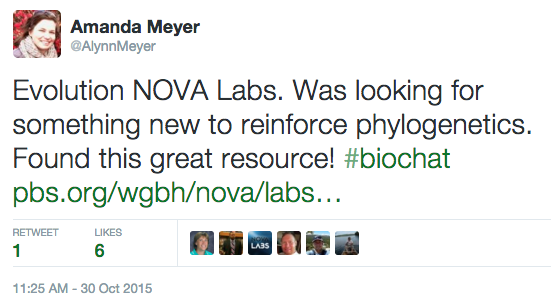
A few weeks ago, I was searching online for something new to supplement the phylogenetics lessons the College Biology class had been working on. When I finally came across a great resource, one of my first instincts was to tweet it out, sharing it with my fellow teaching colleagues.


Screen Shot 2015-11-15 at 8.24.51 AM.png  
It seems as though many teachers are pre-programmed to share. Put two or more science teachers in a room, and it’s my observation that it takes approximately 4.2 minutes (give or take) before they start talking about examples of their favorite lessons, websites, or labs.


So in the spirit of sharing, I’m beginning a series of articles themed, “My Favorite Things.” For each edition of the MnSTA newsletter, my goal is to share with you one website, one book, and one podcast that are “favorites.” Since I’m a Biology teacher, these will mostly concentrate in that discipline area, but I’m hoping as the articles get rolling, I will hear from many science teachers throughout the state of Minnesota, willing to share their favorite things. Yes, this means you! If you have a book, website, or podcast that inspires your teaching or is simply one of those resources you turn to regularly, please contact me (information at the end of this article). Your ideas will be shared here as part of the regular article.


With that said, onto the sharing!


Website: “NOVA Labs: Evolution Lab.” http://www.pbs.org/wgbh/nova/labs/lab/evolution/
Here is the phylogenetics website that had me so excited a few weeks ago. In this “game,” students are guided through a series of missions in which they initially build phylogenetic trees based on traits, fossil evidence, and then eventually DNA similarities. Part of each mission is a tutorial introducing new concepts and tools, with the following challenges getting progressively harder. There are questions at the end of each mission to check students’ new learning, and players can only move on to a new mission once they’ve successfully unlocked the previous one. I was pleased that NOVA covers a wide diversity of organisms in these missions, from bacteria to dinosaurs to hominids. One of the missions also challenges students to consider practical applications of phylogenetics in medicine. It took my students approximately an hour to go through all the missions, and afterwards I asked them to write a paragraph using what they learned in the NOVA Lab as evidence for questions they were exploring in class.


Book: Science Formative Assessment: 75 Practical Strategies for Linking Assessment, Instruction, and Learning by Paige Keeley.
Many of you may have seen or have been using the subject-specific formative assessment probes designed by Keeley, which are wildly popular among science teachers. While I do incorporate a couple of these probes here and there throughout my curriculum, the Keeley-inspired tools I use the most come from this book, Science Formative Assessment. Here, Keeley spells out a variety of generic strategies that can be used in any science class to get a better idea of student thinking. Just in the past quarter, I’ve used at least three ideas from this book. For a recent debate about energy in food chains, students participated in a “Four Corners” assessment. They were asked take a stand on a question by moving to the corner of the room that represented their answer and preparing a “position statement” defending that answer with the other like-minded students in the corner. In preparation for a quiz on classification, students worked in pairs to complete a “Justified True/False” and then rotated through other groups to defend and clarify their justifications. To show changing thinking about photosynthesis and expose misconceptions, I asked students to “Post-It Vote” on a question before exploring the topic in class, and then again afterwards. All three of these methods, and 72 others, are described in detail in Keeley’s book.  


Podcast: Horizontal Transfer by Paul Anderson and David Knuffke
If you teach high school Biology and don’t currently listen to podcasts, this podcast alone should be enough to get you on the bandwagon. Produced by Paul Anderson (of Bozeman Biology video fame) and fellow Biology/Chemistry teacher David Knuffke, Horizontal Transfer is a weekly discussion of ideas, tools, and resources pertinent to all Biology teachers. From topics as specific as “graphing” to broad, philosophical ideas such as, “the ideal high school,” each episode is engaging and entertaining. From the beginning, Paul and David encouraged the listening audience to contribute to the podcast with feedback and “teacher hacks,” which they feature as a regular part of the show. Because of this global collaboration, listening to the podcast makes you feel like a part of a greater community, not just a passive recipient of information. Catching up on past episodes is easy as well, since Paul and David also created a website (of the same name) to archive all the shows and resources.


On a side note, I get asked a lot, “Where do you find the time to listen to podcasts?” Think about all the mindless tasks you may have during the day, and these might be the perfect moments to put on a podcast: a long commute, doing the dishes, raking leaves. Once you get started, you’ll start recognizing all sorts of unclaimed minutes throughout your day. Give it a try!

If you have some “favorite things” you’d like to share with Minnesota science teachers, please send the name of the website, book, or podcast with a short review to Amanda Meyer via email (alynnmeyer@gmail.com) or Twitter (@alynnmeyer). Looking forward to your contributions!

Monday, November 16, 2015

Formative Assessments in Biology

As a part-time technology integrationist for my district, I create a monthly newsletter on Smore for all the staff members. It usually includes updates, ideas from various K-12 classrooms that I've seen, and suggestions for new tools to try. This month, I focused completely on formative assessment. It's been a big part of our PLCs, and after a conversation with some of my colleagues I realized that I use a lot of tech-based formative assessment in Biology.

So this post is a summary of some of the digital formative assessment tools I shared with my staff members in the October newsletter. For each resource, I've provided an explanation of what it is, how it works, and an example from my own classes. I also have a large arsenal of non-tech formative assessment ideas I use in class, mostly based on Paige Keeley's "Science Formative Assessment," which I use weekly. Maybe I'll share some of those in a later blog post!

I know that formative assessment is one of those "buzz words" in education right now, but once I started using targeted methods more thoughtfully to truly probe what my students were thinking, I was just coasting along in class, doing my own thing, oblivious to what my students needed. Bringing in effective formative assessment was the first step in creating a responsive, learner-centered classroom.

Padlet

What?
Are you looking for a good way to get at students' initial ideas about a topic or new content? Padlet is a great tool for aggregating students' thinking so that the entire class can share with each other. This also allows you (and the students) to look for common misconceptions and/or patterns in thinking.

How?
Set up an account online and create a blank Padlet. Each Padlet you make has its own web link, which you can copy and share with students. All the students need to do is go to the web link, click on an empty spot, and then start typing! Students can also add photos and links to their submissions. Although I've always had students access Padlet through a link on Safari, there is also an app.

Example
The photo below shows how Anatomy students shared their questions related to zombie anatomy after watching a series of video clips and making observations. These questions were then connected to the unit on the Nervous System.


Formative

What?
In looking for a digital tool that allowed students to share models in Biology, I came across the web-based tool, Formative. Using Formative, students can answer various types of online questions the teacher has designed. What makes it better than other tools, in my opinion, is that students can draw their answers and there's no log-in or account required for the students.

How?
Once the teacher sets up an account, s/he can design assessments with many different types of questions: multiple choice, show your work, short answer, true/false. You can also add a variety of content to accompany the questions: images, text blocks, a whiteboard, and YouTube videos. After creating the assessment, one option is to copy a link that makes the assessment accessible, even without logging in. Students are immediately prompted to enter their first and last names when they access the link and start the assessment.

Example
Biology students completed an experiment investigating the greenhouse effect this fall. After the experiment, I wanted to know what they thought about their results. Using Formative, I asked them to draw what they thought was happening in their Control and Experimental bottles. Once students submitted their drawings, I could see all of them in one place on my Formative account, making it easy to skim through them and get an idea of where students had gaps in understanding.


Educreations

What?
I have seen many more students using Educreations this year. It's a simple way to make quick videos. Students can add photos, text, and/or drawings to their video, and then narrate over the image they've created. Having the students speak and explain something visually at the same time is a powerful way to get a peek into their thinking.

How?
You as a teacher will set up an Educreations account and classes in that account. Each of your classes will be assigned a class code. When students originally sign up for Educreations in the app, it's good to have your class code handy for them. If they enter your class code, you will automatically see all their completed projects in your Educreations account. Students can also copy a link to their Educreations video and submit that link on Schoology.

Example
After requiring some student research on the Nitrogen Cycle, I wanted to know what they understood so that I could plan out instruction for the standard. So I asked the students to build an Educreations video showing particular terms and describing their current understanding of the cycle. After watching these short videos, I had a much better idea of where they were struggling.


Socrative

What?
Socrative is another type of "quiz builder," but there are a couple of things that I think make it stand out from others. First, some students really like the "space race" option, where the class can watch progress through the quiz as all the individuals or groups completing the quiz move their rockets across the screen as they get more questions correct. Socrative also has very detailed teacher reports, which is something I'm looking for with particular assessments.

How?
After you set up a teacher account, you are assigned a "class number" that will never change. Students can go to Socrative online or via the app, enter your class number, and get right into the quiz. Some other nifty options Socrative offers are "Quick Questions," "Exit Tickets," and different options for pacing within the quizzes.

Example
Before starting the topic of Evolution with Biology students, I wanted to know what common misconceptions they had. I set up a series of true/false questions in Socrative that the students answered before learning anything about Evolution. With Socrative's super-duper reports, I could quickly and easily see that most students were okay with Questions 5 (below), but I knew I definitely needed to focus on Question 1 throughout the unit.


Popplet

What?
Popplet is a mind-mapping app that is super-simple for students to use. A good application for this app is when students have been learning a bunch of different pieces that then need to be connected to a bigger idea. It's another way to encourage students to think critically about their learning - and for you to see if they're ready to extend to that higher level of thinking.

How?
No account required for you, no account required for students. Yay! Students simply open the app, create their Popplet, download the image, and then submit the image to Schoology to share it with their teacher.

Example
In an attempt to help students understand the connections between 2 different standards that they had previously learned (the carbon cycle & climate change), I gave the class a set of "vocabulary" terms from both topics and then tasked them to create a Popplet that connected all of the terms with their own ideas.

Sunday, September 27, 2015

Week 5 for SHS Biology

My original goal for blogging this year was to reflect on my classes each week. Well, the last time I blogged was for Week 1 - how quickly a month passes by! So this post will be a summary of what's been going on in the Springfield Biology classes over the last month, instead of the last week.

Things that have been working well:

  • Leveled Assessments: A change to this year's standards-based format is students completing different assessments for each level. A Level 1 Assessment of a standard is the most basic content knowledge. It serves as a baseline for me to see where the students are starting, and the scores aren't entered into the grade book. A Level 2 Assessment is similar to the Level 1 Assessment, but has less supports. It isn't entered into the grade book either, but students must retake this assessment until they reach proficiency. A Level 3 Assessment is an application question related to the standard, and to reach a Level 4 students have to perform additional research or tutoring for a peer. So far, I'm very happy with how the assessments are working. I like getting that initial information from the students, and I feel more secure that they understand the basics of a standard before we move on to higher-order thinking.
  • Note-taking in College Biology: In past years, I've struggled with assigning students to take notes from their textbook readings. It takes a lot of time to teach them this skill, and it's very challenging for students. However, I've had many past students say they were unprepared for college text reading once they started their degree programs. So this year I used a version of Lee Ferguson's (@thebiospace) notes document to teach note-taking to my College Biology students. We worked on an entire section together, and then they practiced on their own. Another change I made is that they don't read the book for all of their content - sometimes I provide a video instead (for which they use the same notes format). So far the balance has been about 50/50 between textbook content and video content. When they are required to take textbook notes, I keep the length of the section short and make sure the topic is fairly straight-forward. 
  • Climate Conference: I've always felt guilty about the lack of attention I've dedicated to climate change in Biology class. It often gets discussed briefly as a side-note at the end of our discussions about the Carbon Cycle. This year, I was determined to wrap the entire unit about the Carbon Cycle, Photosynthesis, and Respiration around the topic of climate change. The students started by generating questions about a video I showed regarding global temperature changes over time. They then planned and executed their own greenhouse effect investigations, learned about the carbon cycle, investigated photosynthesis & respiration in snails and elodea, and are now in the midst of a Climate Conference simulation, pulling everything they've learned together. I designed this activity to mimic the UN Climate Conference that will take place in Paris in a couple of months. Each of the teams in the class chose a country to represent. Based on that country's needs and limitations, they are designing a plan for their country to cut 10 billions tons of carbon emissions by the year 2055. Plans will be shared and analyzed at our "official" Climate Conference this week.
Things I'd like to improve on:

  • Because I started the topic of climate change with student questions, I need to weave those back into the discussion at the Climate Conference. I haven't quite figured out how I'm going to do this yet.
  • I need to be more clear with my College Biology students about when an assignment is for practice and when it is for assessment. These students are typically very grade-conscious, so I need to lower their stress level by being more transparent about points. It's challenging to use standards-based grading in my 10th grade Biology class and traditional grading in the college-level class. So much of my communication about assessment has been in "SBG" world over the last year, so it's hard to switch back into the traditional mode.
  • Argumentation in Biology: Many of my Biology students are still struggling with portions of the Claim, Evidence, Reasoning framework we use for the scientific argumentation standard in class. They were introduced to this last year, but they are especially confused about dissenting evidence and further research. I need to have more one-on-one conferences with students to help clear up confusion.
There have been lots of great things going on in the classroom, but a month of great things is hard to sum up in one blog post. I'll do my best to write again next week so that I can provide a more detailed account. Until then, enjoy some photos of Springfield students in action.

Where does the mass of a plant come from? Pre-assessment results (A = nutrients in the soil, B = sunlight, C = gasses in the air, D = water). Fascinating outcome; lots of learning yet to happen!
(Clockwise) Working on the greenhouse investigation, watching videos of their classmates' lab results, making banners for the Climate Conference, "choose your own adventure" carbon cycle with QR codes, and diagramming results from the plant energy investigation.