Each month, I share a favorite website, book, and podcast that I’ve found useful for teaching science. This article is shared in the MnSTA Newsletter and cross-posted here.
Many science teachers are probably already familiar with PhET simulations, but I was introduced only a few short years ago, so I’m guessing there are still some of you out there who have yet to be acquainted with this multi-layered resource. At its basic level, the PhET website provides a variety of science simulations from different disciplines, including physics, chemistry, and biology. As a Biology teacher, I’m hoping the designers will continue to bolster the choices in this particular area, but I’ve used the Membrane Channels and Lac Operon simulations nearly every year. Beyond the simulations themselves, there are also activities submitted by teachers linked to each simulation. I was inspired one of these activities to create an inquiry-based “stop-motion” lac operon lesson in my College Biology class. The simulations run best on a PC or laptop, but PhET is in the process of making HTML5 versions of some of their more popular simulations so they are usable on iPads as well.
Book: Remarkable Creatures by Sean Carroll.
Not only is Sean Carroll a Biology rockstar based on the genetics research originating in his lab, but he’s also an engaging popular science author. In Remarkable Creatures, he tells the stories of a handful of individuals whose scientific work has been important in advancing the theory of evolution. Each chapter is dedicated to a different historical figure, from more familiar characters such as Darwin and the Leakey team, to those I had never heard about, like Roy Chapman, whose group discovered the first fossilized “nest” of dinosaur eggs. Research on Neanderthal mtDNA and Neil Shubin’s famous tiktaalik round out the more modern scientific advances at the end of the book. Because each chapter is a stand-alone story, a section of Remarkable Creatures could be easily used in the classroom to supplement a genetics or evolution unit.
Podcast: Big Picture Science from the SETI Institute.
Are you looking for a way to keep up with the newest advances in science, but don’t have enough time to read all the journals? Big Picture Science will provide this for you on a weekly basis, and also manages to translate the research into a cohesive show that is easy to understand, accompanied with splashes of humor. There is a “theme” every week, and each of the science stories in the episode relate to that theme. “Look Who’s Not Talking” was the title of the show I last listened to, with information about the impact of social media on members of the armed services, an interview with one of the programmers for Hello Barbie, and a discussion about various ways people can “disconnect” from devices. If you don’t already use an app to listen to podcasts, you can also download Big Picture Science episodes online at http://radio.seti.org/episodes.
When I started using the Claim, Evidence, Reasoning framework last year, little did I know the transformative power it would have in all aspects of student learning. Opportunities to incorporate scientific argumentation in the classroom continue to present themselves.
The last time I taught College Biology was pre-CER for me, so it's been exciting finding ways to incorporate it into the methods I've traditionally used with this class. One recent shift was a speciation activity from previous years. The original lesson asked students to plot data about the location of various sub-species of the California salamander, Ensatina. Students would then answer questions about the patterns that the sub-species created and eventually be "led" to the possibility that speciation had occurred. Here's a LINK to the original lesson from ENSI. I like that the activity is based on actual research on ring species, initiated by Robert Stebbins from UC Berkley in the 1940's. However students never really puzzled over the data as much as would have liked them to. So, I decided to apply the principles of CER to the activity, hoping to see more critical thinking.
Image from http://evolution.berkeley.edu/evolibrary/article/0_0_0/devitt_02
To start the activity, I shared the story of the Ensatina salamander species with the students. I showed them photos of what the sub-species look like and discussed the history of the research that has benn done on the species. Students then used the data and map from the original activity to plot the locations of the salamanders. At this point, instead of answering scripted questions, I tasked the student teams with (1) Writing a CER argument addressing the question, How did speciation of the Ensatina salamanders occur in California? (2) Diagramming a whiteboard model to support their argument. Remember, the students had no knowledge of the actual scientific result of this research.
The discussions teams had while developing their CER and whiteboard models were exactly the type of thinking I was hoping for. Students debated which sub-species was the most ancestral, why salamanders in different areas of California looked so different, and applied topics from class such as disruptive selection, habitat isolation, and hybridization. Each of their models and arguments ended up being a little different. Since we didn't have time to run an official white boarding "class conference," I asked every team to create a video describing their CER with the whiteboard model as a prop in the video.
This wasn't the end of the activity, however. I wanted the students to evaluate each others' arguments. Also, I no longer give points for group work, so I was searching for a way to assess my students individually on this topic. What I decided to do was this: Each student watched three CER videos from teams other than their own. After watching the videos, they critiqued the arguments discussed in the videos by responding to the prompts below.
1) Compare and contrast the speciation arguments in the three videos you watched.
2) In your opinion, which team developed the strongest argument? Why? (Discuss the qualities of all three arguments in your explanation.)
3) Describe two additional pieces of information that would have improved all the groups' arguments. In other words, if you could request that the original salamander scientists provide you with more data or information, what would have been helpful to know to support the arguments?
The results were outstanding. Students dug into the arguments of their peers and provided very insightful analyses of evidence.
Here are some excerpts of student work from the peer critique:
I was extremely happy with the outcome of this CER lesson. Not only was the content of the course reinforced, but students participated in powerful science practices. Double win!
What follows is an article I wrote for the most recent MnSTA Newsletter. The online version can be found HERE for people who are members of MnSTA.
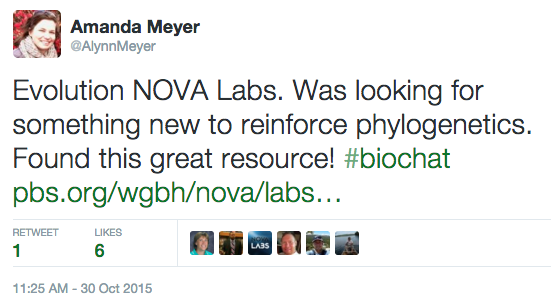
A few weeks ago, I was searching online for something new to supplement the phylogenetics lessons the College Biology class had been working on. When I finally came across a great resource, one of my first instincts was to tweet it out, sharing it with my fellow teaching colleagues.
It seems as though many teachers are pre-programmed to share. Put two or more science teachers in a room, and it’s my observation that it takes approximately 4.2 minutes (give or take) before they start talking about examples of their favorite lessons, websites, or labs.
So in the spirit of sharing, I’m beginning a series of articles themed, “My Favorite Things.” For each edition of the MnSTA newsletter, my goal is to share with you one website, one book, and one podcast that are “favorites.” Since I’m a Biology teacher, these will mostly concentrate in that discipline area, but I’m hoping as the articles get rolling, I will hear from many science teachers throughout the state of Minnesota, willing to share their favorite things. Yes, this means you! If you have a book, website, or podcast that inspires your teaching or is simply one of those resources you turn to regularly, please contact me (information at the end of this article). Your ideas will be shared here as part of the regular article.
Here is the phylogenetics website that had me so excited a few weeks ago. In this “game,” students are guided through a series of missions in which they initially build phylogenetic trees based on traits, fossil evidence, and then eventually DNA similarities. Part of each mission is a tutorial introducing new concepts and tools, with the following challenges getting progressively harder. There are questions at the end of each mission to check students’ new learning, and players can only move on to a new mission once they’ve successfully unlocked the previous one. I was pleased that NOVA covers a wide diversity of organisms in these missions, from bacteria to dinosaurs to hominids. One of the missions also challenges students to consider practical applications of phylogenetics in medicine. It took my students approximately an hour to go through all the missions, and afterwards I asked them to write a paragraph using what they learned in the NOVA Lab as evidence for questions they were exploring in class.
Book: Science Formative Assessment: 75 Practical Strategies for Linking Assessment, Instruction, and Learningby Paige Keeley.
Many of you may have seen or have been using the subject-specific formative assessment probes designed by Keeley, which are wildly popular among science teachers. While I do incorporate a couple of these probes here and there throughout my curriculum, the Keeley-inspired tools I use the most come from this book, Science Formative Assessment. Here, Keeley spells out a variety of generic strategies that can be used in any science class to get a better idea of student thinking. Just in the past quarter, I’ve used at least three ideas from this book. For a recent debate about energy in food chains, students participated in a “Four Corners” assessment. They were asked take a stand on a question by moving to the corner of the room that represented their answer and preparing a “position statement” defending that answer with the other like-minded students in the corner. In preparation for a quiz on classification, students worked in pairs to complete a “Justified True/False” and then rotated through other groups to defend and clarify their justifications. To show changing thinking about photosynthesis and expose misconceptions, I asked students to “Post-It Vote” on a question before exploring the topic in class, and then again afterwards. All three of these methods, and 72 others, are described in detail in Keeley’s book.
Podcast: Horizontal Transferby Paul Anderson and David Knuffke
If you teach high school Biology and don’t currently listen to podcasts, this podcast alone should be enough to get you on the bandwagon. Produced by Paul Anderson (of Bozeman Biology video fame) and fellow Biology/Chemistry teacher David Knuffke, Horizontal Transfer is a weekly discussion of ideas, tools, and resources pertinent to all Biology teachers. From topics as specific as “graphing” to broad, philosophical ideas such as, “the ideal high school,” each episode is engaging and entertaining. From the beginning, Paul and David encouraged the listening audience to contribute to the podcast with feedback and “teacher hacks,” which they feature as a regular part of the show. Because of this global collaboration, listening to the podcast makes you feel like a part of a greater community, not just a passive recipient of information. Catching up on past episodes is easy as well, since Paul and David also created a website (of the same name) to archive all the shows and resources.
On a side note, I get asked a lot, “Where do you find the time to listen to podcasts?” Think about all the mindless tasks you may have during the day, and these might be the perfect moments to put on a podcast: a long commute, doing the dishes, raking leaves. Once you get started, you’ll start recognizing all sorts of unclaimed minutes throughout your day. Give it a try!
If you have some “favorite things” you’d like to share with Minnesota science teachers, please send the name of the website, book, or podcast with a short review to Amanda Meyer via email (alynnmeyer@gmail.com) or Twitter (@alynnmeyer). Looking forward to your contributions!
As a part-time technology integrationist for my district, I create a monthly newsletter on Smore for all the staff members. It usually includes updates, ideas from various K-12 classrooms that I've seen, and suggestions for new tools to try. This month, I focused completely on formative assessment. It's been a big part of our PLCs, and after a conversation with some of my colleagues I realized that I use a lot of tech-based formative assessment in Biology.
So this post is a summary of some of the digital formative assessment tools I shared with my staff members in the October newsletter. For each resource, I've provided an explanation of what it is, how it works, and an example from my own classes. I also have a large arsenal of non-tech formative assessment ideas I use in class, mostly based on Paige Keeley's "Science Formative Assessment," which I use weekly. Maybe I'll share some of those in a later blog post!
I know that formative assessment is one of those "buzz words" in education right now, but once I started using targeted methods more thoughtfully to truly probe what my students were thinking, I was just coasting along in class, doing my own thing, oblivious to what my students needed. Bringing in effective formative assessment was the first step in creating a responsive, learner-centered classroom.
Padlet
What? Are you looking for a good way to get at students' initial ideas about a topic or new content? Padlet is a great tool for aggregating students' thinking so that the entire class can share with each other. This also allows you (and the students) to look for common misconceptions and/or patterns in thinking.
How? Set up an account online and create a blank Padlet. Each Padlet you make has its own web link, which you can copy and share with students. All the students need to do is go to the web link, click on an empty spot, and then start typing! Students can also add photos and links to their submissions. Although I've always had students access Padlet through a link on Safari, there is also an app.
Example The photo below shows how Anatomy students shared their questions related to zombie anatomy after watching a series of video clips and making observations. These questions were then connected to the unit on the Nervous System.
Formative
What? In looking for a digital tool that allowed students to share models in Biology, I came across the web-based tool, Formative. Using Formative, students can answer various types of online questions the teacher has designed. What makes it better than other tools, in my opinion, is that students can draw their answers and there's no log-in or account required for the students.
How? Once the teacher sets up an account, s/he can design assessments with many different types of questions: multiple choice, show your work, short answer, true/false. You can also add a variety of content to accompany the questions: images, text blocks, a whiteboard, and YouTube videos. After creating the assessment, one option is to copy a link that makes the assessment accessible, even without logging in. Students are immediately prompted to enter their first and last names when they access the link and start the assessment.
Example Biology students completed an experiment investigating the greenhouse effect this fall. After the experiment, I wanted to know what they thought about their results. Using Formative, I asked them to draw what they thought was happening in their Control and Experimental bottles. Once students submitted their drawings, I could see all of them in one place on my Formative account, making it easy to skim through them and get an idea of where students had gaps in understanding.
Educreations
What? I have seen many more students using Educreations this year. It's a simple way to make quick videos. Students can add photos, text, and/or drawings to their video, and then narrate over the image they've created. Having the students speak and explain something visually at the same time is a powerful way to get a peek into their thinking.
How? You as a teacher will set up an Educreations account and classes in that account. Each of your classes will be assigned a class code. When students originally sign up for Educreations in the app, it's good to have your class code handy for them. If they enter your class code, you will automatically see all their completed projects in your Educreations account. Students can also copy a link to their Educreations video and submit that link on Schoology.
Example After requiring some student research on the Nitrogen Cycle, I wanted to know what they understood so that I could plan out instruction for the standard. So I asked the students to build an Educreations video showing particular terms and describing their current understanding of the cycle. After watching these short videos, I had a much better idea of where they were struggling.
Socrative
What? Socrative is another type of "quiz builder," but there are a couple of things that I think make it stand out from others. First, some students really like the "space race" option, where the class can watch progress through the quiz as all the individuals or groups completing the quiz move their rockets across the screen as they get more questions correct. Socrative also has very detailed teacher reports, which is something I'm looking for with particular assessments.
How? After you set up a teacher account, you are assigned a "class number" that will never change. Students can go to Socrative online or via the app, enter your class number, and get right into the quiz. Some other nifty options Socrative offers are "Quick Questions," "Exit Tickets," and different options for pacing within the quizzes.
Example Before starting the topic of Evolution with Biology students, I wanted to know what common misconceptions they had. I set up a series of true/false questions in Socrative that the students answered before learning anything about Evolution. With Socrative's super-duper reports, I could quickly and easily see that most students were okay with Questions 5 (below), but I knew I definitely needed to focus on Question 1 throughout the unit.
Popplet
What? Popplet is a mind-mapping app that is super-simple for students to use. A good application for this app is when students have been learning a bunch of different pieces that then need to be connected to a bigger idea. It's another way to encourage students to think critically about their learning - and for you to see if they're ready to extend to that higher level of thinking.
How? No account required for you, no account required for students. Yay! Students simply open the app, create their Popplet, download the image, and then submit the image to Schoology to share it with their teacher.
Example In an attempt to help students understand the connections between 2 different standards that they had previously learned (the carbon cycle & climate change), I gave the class a set of "vocabulary" terms from both topics and then tasked them to create a Popplet that connected all of the terms with their own ideas.
My original goal for blogging this year was to reflect on my classes each week. Well, the last time I blogged was for Week 1 - how quickly a month passes by! So this post will be a summary of what's been going on in the Springfield Biology classes over the last month, instead of the last week.
Things that have been working well:
Leveled Assessments: A change to this year's standards-based format is students completing different assessments for each level. A Level 1 Assessment of a standard is the most basic content knowledge. It serves as a baseline for me to see where the students are starting, and the scores aren't entered into the grade book. A Level 2 Assessment is similar to the Level 1 Assessment, but has less supports. It isn't entered into the grade book either, but students must retake this assessment until they reach proficiency. A Level 3 Assessment is an application question related to the standard, and to reach a Level 4 students have to perform additional research or tutoring for a peer. So far, I'm very happy with how the assessments are working. I like getting that initial information from the students, and I feel more secure that they understand the basics of a standard before we move on to higher-order thinking.
Note-taking in College Biology: In past years, I've struggled with assigning students to take notes from their textbook readings. It takes a lot of time to teach them this skill, and it's very challenging for students. However, I've had many past students say they were unprepared for college text reading once they started their degree programs. So this year I used a version of Lee Ferguson's (@thebiospace) notes document to teach note-taking to my College Biology students. We worked on an entire section together, and then they practiced on their own. Another change I made is that they don't read the book for all of their content - sometimes I provide a video instead (for which they use the same notes format). So far the balance has been about 50/50 between textbook content and video content. When they are required to take textbook notes, I keep the length of the section short and make sure the topic is fairly straight-forward.
Climate Conference: I've always felt guilty about the lack of attention I've dedicated to climate change in Biology class. It often gets discussed briefly as a side-note at the end of our discussions about the Carbon Cycle. This year, I was determined to wrap the entire unit about the Carbon Cycle, Photosynthesis, and Respiration around the topic of climate change. The students started by generating questions about a video I showed regarding global temperature changes over time. They then planned and executed their own greenhouse effect investigations, learned about the carbon cycle, investigated photosynthesis & respiration in snails and elodea, and are now in the midst of a Climate Conference simulation, pulling everything they've learned together. I designed this activity to mimic the UN Climate Conference that will take place in Paris in a couple of months. Each of the teams in the class chose a country to represent. Based on that country's needs and limitations, they are designing a plan for their country to cut 10 billions tons of carbon emissions by the year 2055. Plans will be shared and analyzed at our "official" Climate Conference this week.
Things I'd like to improve on:
Because I started the topic of climate change with student questions, I need to weave those back into the discussion at the Climate Conference. I haven't quite figured out how I'm going to do this yet.
I need to be more clear with my College Biology students about when an assignment is for practice and when it is for assessment. These students are typically very grade-conscious, so I need to lower their stress level by being more transparent about points. It's challenging to use standards-based grading in my 10th grade Biology class and traditional grading in the college-level class. So much of my communication about assessment has been in "SBG" world over the last year, so it's hard to switch back into the traditional mode.
Argumentation in Biology: Many of my Biology students are still struggling with portions of the Claim, Evidence, Reasoning framework we use for the scientific argumentation standard in class. They were introduced to this last year, but they are especially confused about dissenting evidence and further research. I need to have more one-on-one conferences with students to help clear up confusion.
There have been lots of great things going on in the classroom, but a month of great things is hard to sum up in one blog post. I'll do my best to write again next week so that I can provide a more detailed account. Until then, enjoy some photos of Springfield students in action.
Where does the mass of a plant come from? Pre-assessment results (A = nutrients in the soil, B = sunlight, C = gasses in the air, D = water). Fascinating outcome; lots of learning yet to happen!
(Clockwise) Working on the greenhouse investigation, watching videos of their classmates' lab results, making banners for the Climate Conference, "choose your own adventure" carbon cycle with QR codes, and diagramming results from the plant energy investigation.
Every year, I change my Week 1 strategy a bit (or a lot) in an attempt to meet the following goals:
Get to know my students a little.
Help my students begin to know me.
Begin building classroom culture.
Give the students some information about what to expect from class.
Allow the students some input regarding the class.
Solidify routines and procedures that are important to student learning.
Do some science.
And do all of this in an efficient way so that I don't drag the "intro to class stuff" on so long that it's October before students actually start digging into the content! So much to do in so little time...
This year, I decided to organize all of these goals around "themes" that I felt were important to learning in Biology class: Persistence, Teamwork, Problem-Solving, and Curiosity. Here's the low-down on what the students did to explore these themes.
Monday
We had 20 minute classes on the first day of school (and my first hour Biology class was even shorter), so we only had time to do the following:
"Warm-Up." This is one of those procedures I want students to get used to. Every day when they come into class, there is something on the board for them to do. Today, they had to write their name on a popsicle stick. I'm old-school and use these for calling on students or making lab groups throughout the year. I like them better than any digitized name-picker I've come across.
I showed an Intro to Biology Video (below). This one gets my adrenaline racing every time.
I explained how to access and interact with the Course Overview video. I created a video of me talking through the Course Overview. I put it into Zaption and added various interactive questions to it, as well as places where I asked for student feedback and comments. The students had the whole week to find time to watch this 10-minute video, and we'll discuss it more on Monday or as the need arises. Personally, I really dislike talking through the course overview in class.
Tuesday
The "Warm-Up" for the day was to complete the "Get To Know You" survey from Panorama Education (click here). This is only my first year of using the survey, but I'm kind of digging it so far. I took the survey first, and then after the students took it, the survey gave them information about how their answers were similar to mine. And I received analogous information about the students as well. I like the instantaneous connections.
Students worked in partners on this "Saving Sam" activity (click here). Themes that this addressed are Persistence, Teamwork, and Problem-Solving. After the activity, student teams brainstormed what this activity indicated to them about learning in Biology class. I recorded all of their answers on a huge Post-It note.
"Saving Sam" success!
Wednesday
The "Warm-Up" today was to sign up for Remind for the class. Then students received their science notebook and started getting it organized. I've had the students use composition notebooks for science for many years now. This is definitely an integral procedure for my classes. Lee Ferguson has a nice set of videos on how to set these up. Here's the first:
Students explored ice balloons as a way to generate questions. This is an activity I've done for quite a few years. I picked it up at an inquiry workshop and modified it to fit my needs. Students get a tray with a frozen water balloon, some dissecting probes, a thermometer, food coloring, salt, sugar, and corn starch. They have approximately 10 minutes to explore the ice balloon using the tools (and keeping it in the tray). While they're experimenting, each student has a stack of small papers they use to record their questions about the process - one question per paper. When they're done, a team of 3-4 students should have a large stack of questions generated. I then briefly define open vs. closed questions, students sort their questions into open and closed, and finally record a few examples of each in their notebooks. Themes this activity addresses are Teamwork, Problem-Solving, and Curiosity. It was also a good introduction to my expectations for materials use and clean-up in the Biology lab.
Once again, when the activity was done, I asked students to reflect on what this experience indicated to them about learning in Biology class, and I recorded their ideas on a second giant Post-It note.
Exploring ice balloons.
Thursday
For the "Warm-Up," students practiced changing questions from closed to open and open to closed. This is getting them prepared for the Question Formation Technique we'll be using in class, based on the book, Make Just One Change, by Rothstein & Santana. (Click here for a link.)
The students started on an activity I have never done in the past, but feel is becoming increasingly important in my classes: how to evaluate online sources. I try to emphasize in my course that students have unlimited information at their fingertips and I am not the sole provider of knowledge. However I've realized that students don't know how to find and/or evaluate digital content. So I put together a series of short exercises to help them with this.
1. Establish the need. I asked the students to all put the question "Are vaccinations safe?" into the search bar on Safari. (My students all have iPads.) I then assigned each student a site from the list that was generated. I did this by number: student 1 had site 1 at the very top, student 2 had the next site down, etc. Their task was to skim the site and decide how it answered the question - yes or no. Students then pasted a copy of their site's url and the "yes" or "no" answer onto a class Padlet to share the results. As you can see below, the sites ranged from .gov to .org to .com and more, and students found both yes and no answers. I used this as a springboard to point out the fact that different sites provide different answers, so our job as question-askers is to sift through for the most credible resources.
Padlet results for top 20+ online hits: Are vaccinations safe?
2. What is credible? Students were then given the titles and urls of 11 different websites and asked to rank them (based on name and url only) in order of credibility.
Like many of my new ideas, this one went longer than expected, so we stopped here for the day.
I introduced the first homework assignment of the year - what I called a "practice assignment." Instead of lecturing in class, students access content outside of class via iBook, video, website, or traditional textbook. Students choose which learning tool they prefer. I provide them with guiding questions to write about as they move through the content, and then students fill out an online feedback form. To practice this type of assignment for the first time, I put together some resources on Ebola. We won't be discussing the content for a few days, but I always try to give students multiple days to get assignments like this done so that they can plan around wifi needs and busy schedules.
Friday
The "Warm-Up" today was only possible thanks to this great spreadsheet shared by Alice Keeler (click here) designed to collect and organize student ideas for tweeting. I asked the students to tweet (using the shared spreadsheet) about one thing they learned, still wondered about, or something that just stuck with them from class this week. I'm planning on asking the students to do this every Friday as a warm-up. Research on memory shows that if learners wait a while after learning something, and then go back to access that information at a later time, they're more likely to remember it long-term. By the way, you can see some of my students' tweets from this warm-up at @MeyerScience.
To continue the credibility evaluation from the previous day, student partner groups were assigned one of the 11 sites to actually visit and determine everything they could about the author of the site. Was it one or more authors? Was there an editor? Were the authors restricted? What was the educational background of the authors? Did the authors have a bias or affiliation with a particular cause? Was the author monetarily sponsored in any way?
Students reported back what they found and then re-ranked the sites as a class (with very different results from the initial ranking).
I still have one more activity related to credibility of online sources that I'm going to present to the students on Monday (it's all about using Wikipedia correctly), and then we'll create one more giant sticky note about the experience. The themes that this one addresses are Problem-Solving and Curiosity. After this last activity is done, students will participate in a "chalk talk" to summarize all their Post-It note ideas under three topics: What can I expect of my teammates in Biology class? What can I expect of my teacher in Biology class? What can other expect of me in Biology class?
More than any other year, I feel like the time spent during this first week was a nice balance of my goals. The true test will be the outcome of the chalk talk on Monday. I'll report back next week!
Based on a completely unscientific examination of my recent social media connections, there has been a lot of chatter about the nuances of socializing during educational conferences. More specifically, some conference attendees have felt left out, snubbed, or simply ignored by their peers. A few post-ISTE15 blog posts addressed this phenomenon, as well as less directly, some reflections from FlipCon15. It seems as though the relatively new advent of virtual PLN's and the seemingly exponential growth of the edu-famous entourage have collided to form the perfect storm at educational conferences.
Some teachers have friends around the country (or around the world) that they are only able to visit face to face once or twice a year. The conference is like a lifeline for these types of relationships, so of course they want to spend as much time as possible with these colleagues. On the other hand, some attendees have only "known" a favorite presenter or blogger or podcaster virtually, but have learned from or been inspired by him/her. Of course they want the chance to meet that individual in person at the conference to thank him/her or just socialize for a while.
What results is a sometimes uncomfortable situation in which a conference attendee might feel like s/he is back in high school, sitting at the lunch table all alone, while the cool kids whoop it up a few tables away.
Well, I've decided it's time I add my two cents worth on this topic. Please note that these are strictly opinions based on one person's experience (mine!), but here are my limited credentials:
I'm an introvert at heart.
I have my own edu-heroes whose podcasts I listen to, blogs I read, and/or Twitter accounts I follow.
I have no problem starting up a conversation with someone on social media, but I am a little more shy in person.
I've attended a variety of national conferences, sometimes with close friends, but usually on my own.
So, with that glimpse into my psyche, here are my ideas about what we could do to better avoid creating "high school cafeterias" at our education conferences. I think some of these strategies would help more attendees to feel included, but also allow for those "PLN reunions" to happen.
Changes at the Attendee Level
1. Individuals that are planning on attending a conference, especially a national conference, should spend time before the conference connecting with other attendees digitally. Get on social media and find out who's going to be there. Set up some "outings" or "meet-ups" ahead of time so there's some guaranteed face to face time. Advertise which sessions you might be attending so that you can pre-connect with others who will also be there. This ensures a friendly face to look for when you get into the room.
2. If you happen to go to a session in which you don't know anyone, introduce yourself to the people sitting next to you. You'd be amazed at the stories and knowledge your "next door neighbor" has. I met some of my most interesting connections at NSTA15 last winter using this philosophy. You might not get the chance to have a coffee with that edu-famous presenter you really wanted to meet, but I'm here to tell you that there are a ton of amazing educators in the audience that would love to meet you and chat.
3. For those educators who do know a lot of people at the conference and have been looking forward to spending time together, I think it's courteous to make one simple change: Avoid adding the conference hashtag to your personal tweets. Looking to get your PLN together for dinner? Sharing an inside joke? Reminiscing about past gatherings? Those tweets are targeted to a specific, select group and don't need to be shared with all the conference attendees. It only makes other people feel like they're missing something when they really aren't a part of this insular conversation that you've made public. I'm not saying that you shouldn't have these Twitter conversations with your buds; I just feel like there's no need to use the conference hashtag with these tweets. Hashtagging should be for conversations about experiences, ideas, and learning that all people can feel a part of.
Changes at the Presenter Level
1. If I were to lecture in the classroom, I wouldn't continue for very long before I took a break and asked students to process that information in some way. Similarly, I feel like part of a presenter's responsibility is to allow time for attendees to bounce ideas off each other during the presentation. This not only allows an opportunity for the genius of the room to be uncorked, but it also has the potential to get people talking to others they may have never otherwise met. You could even be really crazy and purposefully mix up those groups so that attendees don't only talk to the people they chose to sit with. Give your attendees time to verbally process with each other and the opportunity to meet a like-minded friend.
2. Keep in touch with the attendees who contact you. If someone at your session tweets about it, respond with a "favorite" or written reply. If you receive any correspondence later about questions or resources, make sure to take the time to answer. I'm sure it can get a little overwhelming if you receive a lot of requests, but if you're going to put yourself out there as a presenter, I feel like you have a responsibility to "walk the talk."
Changes at the Conference Level
The conference format can go a long ways in allowing for different types of interactions amongst participants. Based on the conferences I've attended, here are some "format" ideas that I think work well to achieve a balance amongst the myriad of attendees' social expectations.
1. Provide communal meals onsite and make sure there's enough time to eat them. Let's face it, a lot of our conference socializing is done over drinks or a cheeseburger. For those attendees that don't know a lot of people at the conference, a communal meal is a great place to meet someone new. No need to worry about finding a lunch date, just simply join a table. Sometimes tables are explicitly organized by interests so everyone has a "home," but they don't need to be. We're all adults and should feel somewhat comfortable (albeit, a little awkward) joining a table of strangers for dinner. For attendees that already have a group of friends they'd like to spend time with, a nice long meal time allows the opportunity to eat outside of the conference and catch up.
2. Plan for a variety of session types, some of which are meant to simply bring people together. Many big conferences will have a "first-timers" breakfast to kick off the conference. FlipCon has scheduled time for job-alike sessions for people to meet each other and share ideas. One of my favorite memories from ISTE14 was attending the "Birds of a Feather" gatherings that united educators around common interests or passions. I met so many intelligent, friendly colleagues at those sessions. Traditional conference sessions can be very one-directional. The presenter or the panel "talks at you" and there is no community connectedness. This is fine for some topics, but conference planners need to make sure that there are also many scheduled, intentional opportunities for conversations to happen.
A conference is what you make of it and adaptable to what you need from it. Just remember that everyone attends conferences for different reasons. Presenters and conference planners can do a lot to help ensure that attendees with diverse needs are all satisfied. But at the same time, your attitude, courage, and empathy can go a long way in making each conference a valuable experience.
Photo from Denisefg87 on Flickr, available via Creative Commons.