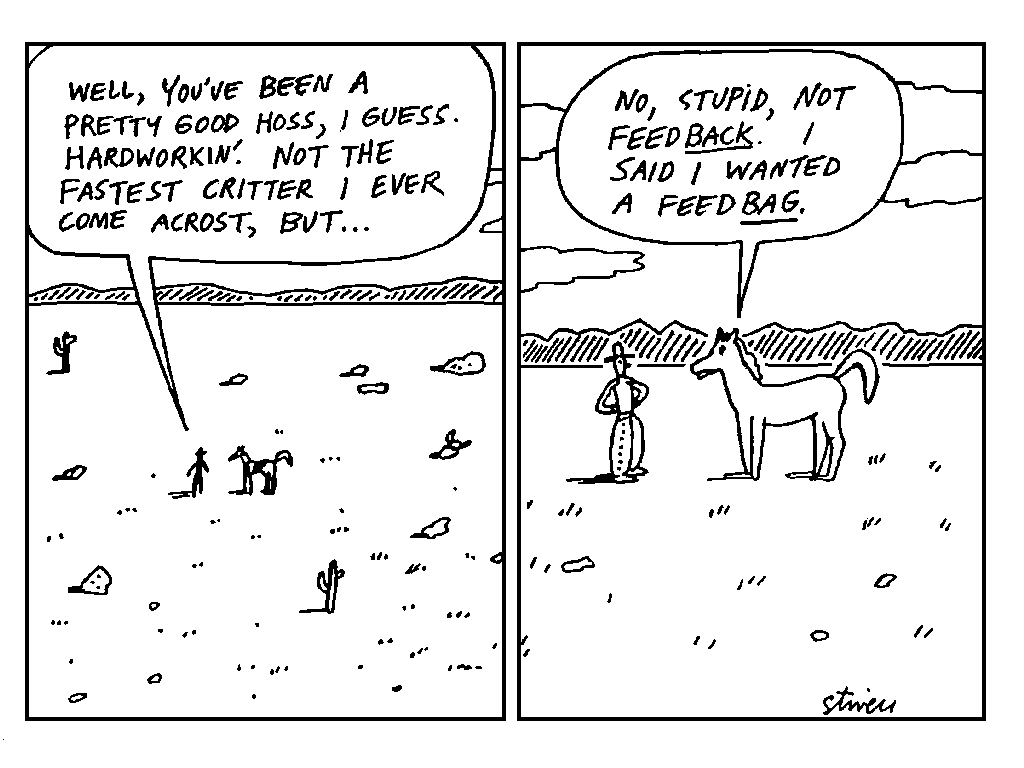
Sunday, September 14, 2014

What Does Your Feedback Say to Students?


This post is part of the 30-Day Blog Challenge from TeachThought. To learn more about the challenge go to www.teachthought.com/teaching/reflective-teaching-30-day-blogging-challenge-teachers/.

DAY 14: What is feedback for learning, and how well do you give it to students?

It's a little ironic that I sit down to write this post after just spending a couple hours on a Sunday evening writing feedback on student lab reports. As I was writing comments, questions, and suggestions for my students to improve their work, I was thinking about how I used to provide "feedback" for students. When I first started teaching, I'd correct a lab report by referring to the rubric to count up all the errors they made, and then give them a score. Done. Done for me and done for them.

Consider what this type of "feedback" says to students. It says,

"This was your one shot to prove to me what you can do, and you blew it." 
"This one-time score will forever impact your overall success in this class." 
"Your teacher holds all the knowledge, and s/he found you lacking." 
"Your learning is done."

Slowly, as I became less satisfied with this type of "feedback," I began to experiment with different ways of using feedback to help my students learn, instead of using it as a signal for the end of learning in the form of a grade. Even the idea that the teacher, "corrects assignments" is limiting to student learning. Instead, I started asking students to make the corrections on their assignments, and used key words to indicate what types of corrections they should consider. "EM" meant "Explain More" and "SP" meant "Be more Specific." I stopped recording scores in the grade book until the students' work met the standard that had been established. And for the first time this year, I'm using Standards Based Grading in my classes.

Here is an example of comments from the assignment I was assessing tonight. The students created their own experiments, and wrote a procedure, data table, and analysis for their experiment based on rubrics. They submitted their work over Schoology, I then evaluated their work based on which level of the rubric they reached, and left comments in Schoology. Only assignments that reached a "3" on a given rubric were recorded as a score. Everything else is considered a "Work in Progress," a handy option in our district's grade book.


Students are then given time to consider my feedback and make corrections, after which I look over their work a second time and follow the same process. This cycle continues until the student reaches all "3's" or higher, or the end of the quarter - whichever comes first.

I've become more intentional about including peer evaluation in the feedback process as well. Before students submitted the above assignment to me, the procedure had been read and evaluated by four other students, and the data and analysis had been read and evaluated by two other students. In this evaluation, students had to determine if the work was at the 1, 2, 3, or 4 level based on the rubric. If it wasn't yet at a 3, they wrote comments for the owner of the assignment to help him/her improve the work. In my first experiment with peer feedback in class this year, it didn't seem to significantly improve the students' learning. But I'm not sure yet if that's because the evaluating student wasn't serious about his/her role, or if the student receiving the feedback didn't act upon the suggestions. Nonetheless, I'm committed to making peer feedback a permanent and regular part of science class. The students will be evaluating another lab report for their classmates this week.

I'm sure the practice and implementation of feedback in my classroom will continue to evolve, but I'm confident in saying that its purpose has been cemented in place. I will never again use feedback to squelch learning, as my grading practices did in the past. Feedback will continue to be a way to say to students,

"Take this chance to learn more deeply."
 "Try to see your work from a different perspective."
"Your learning is more complex and important than one score can show."
"While you're trying to improve, I'm willing to give you the time and input you need to do so."

*Image from flickr, licensed under Creative Commons: 
https://www.flickr.com/photos/karlhorton/1903050006/in/photolist-3UaCt1-fHDzMS-fHn2Xp-8EqL2E-f2NoAs-fHn2Li-fHDxZf-fHmZW8-7VieK3-hNBVNS-f2y8tp-f2NnPu-6AsfvS-8pCp4W-jYXzr-4MP1vf-4MP1nY-6AsbBE-pFFHx-4pLkm8-f2y8ia-8dHRBG-6Ao8nK-jYXvo-5cUhAa-6Ao5Sk-6Ao8N8-6Asdcj-6d2bwc-6Ao9kX-6Ao67t-f2y9HP-nXyYE6-dnNNJt-nQ5aQ3-9E4LD8-8CsTbz-hFv6Qm-7iN1DE-e987Cm-H8bdJ-6bgoC9-f2ya3F-5cYBEb-f2y93D-7X3Pgt-5cYBCG-akiPKg-akmCx3-hFuSLs

Saturday, September 13, 2014

Frosting Without The Cake


This post is part of the 30-Day Blog Challenge from TeachThought. To learn more about the challenge go to www.teachthought.com/teaching/reflective-teaching-30-day-blogging-challenge-teachers/.

DAY 13: Name the top edtech tools you use on a consistent basis in the classroom, and rank them in terms of their perceived (by you) effectiveness.

Writing about technology tools in the classroom is not my favorite topic for a blog post. After all, without strong pedagogy, the tools are simply frosting without the cake. And I really don't like frosting on its own; it's way too sweet. But since I have benefitted from reading so many other writers' posts about edtech tools in the past, it's time I give back and contribute to the conversation.

Here is a list of every tech tool my students or I used in the first four weeks of the school year, as well as how often it was used:
  • Schoology (nearly every day)
  • Google Forms (4 days)
  • TED video (1 day)
  • Remind (12 days)
  • YouTube (5 days)
  • Google Docs app, Pages app, and/or Notability app (4 days)
  • Camera app for video (3 days)
  • Padlet (3 days)
  • Weebly (1 day)
  • Nearpod (1 day)
  • Zaption (2 days)
  • Answer Garden (1 day)
  • Planbook.com (every day)
Despite the LMS-bashing that seems to be circulating on my Twitter feed right now, I have to say I love Schoology and I'm not ashamed to admit it! Yes, it's amazing to have everything the student needs for class in one place, but what I love even more is not how it facilitates sharing between me and my students, but how Schoology allows students to share with each other more easily. The discussion feature is flexible enough to be used for sharing all sorts of ideas between students. For example, I recently challenged my Anatomy students to share one question they still had about the kidney in a Schoology discussion, and then search for and post a resource that answered the question so that we could develop a class repository of information about the topic. In Biology, students were able to share lab results with their classmates by uploading videos to Schoology. Students discussed their results in a video and then uploaded the product to a Schoology media album so their classmates could use the results for a final conclusion write-up.

The other high-use tool on this list is Planbook.com. If you don't already have an online lesson-planning tool you love, you definitely need to consider this one. For the very reasonable price of $12 per year, you get a nicely-organized planbook with lots of bells and whistles. Here are some of the features about it I love:

- I used to have Post-It notes all over my paper planbook because of all the adjusting to lessons I did every week. With an online planbook, changes are easier to record and less messy.
- It has an iPad app that has all the same features as the desktop version.
- You can link photos and websites into your plans. So if I have a lab set-up I want to make sure to remember for next year, I just snap a photo of it and upload it to that specific day and lesson in Planbook.
- If you are a teacher who shares a week's worth of lessons with students so they can plan ahead, it has an option to create a link for students to view your planbook. But I can still write notes to myself in the planbook that the students can't see.

I expect Weebly use to become more common in my classes as the year progresses. The students just started their Weebly accounts on Friday, but they will be using them on a weekly basis from now on. Weebly will be the platform for their e-portfolios. Because I'm diving into standards-based grading this year, I really wanted to have a way for students to evaluate their own work and only submit their best work to me to be graded. The Weebly accounts are personal websites that will be used by students to share their work. I was able to create my classes after initiating my own account, and then set up each of my students in a class with a username and password. Weebly has been very thoughtful in their planning for teacher oversight of the student websites.  I don't have to allow the websites to be public right away, but I still have access to view all of them.

All of the other tools are used sporadically throughout the week. If you have any questions about how I use these other tools on my list, please let me know!

Photo by Maddie Keating, "One Hundred Eighty Four," from Flickr, licensed via Creative Commons.

Friday, September 12, 2014

My Student-Focused Future


This post is part of the 30-Day Blog Challenge from TeachThought. To learn more about the challenge go to www.teachthought.com/teaching/reflective-teaching-30-day-blogging-challenge-teachers/.

DAY 12: How do you envision your teaching changing over the next 5 years?

For the first time in 12 years of teaching, the new school year started without me explaining a single classroom "rule" for my students. In past years, I'd read numerous articles about teachers who worked together with their students to develop the classroom rules, and although this option felt okay to me, it still wasn't quite what I was looking for. Finally, this fall, I came across this article from Edutopia about establishing classroom norms.  Here was an approach that made sense to me. I liked the combination of student independence and community-building inherent in the process. It took us over 3 weeks to step through a process of creating classroom norms, but it was definitely worthwhile. After students generated norms individually, as teams, and then as a class, we chose key words as reminders of the type of learning environment they wanted to create. The photo above shows each of the key words the students felt were important, signed off on, and hung around the room.

The reason I share this anecdote is because I believe it symbolizes a significant shift in my learning philosophy. I have found that my teaching has become more student-centered over the past five years. I've begun to focus less on "getting through" the content and more on helping students ask questions, creating opportunities for student choice, and emphasizing learning as a process.  This shift started with small changes like incorporating teams and flipping the classroom. Last year I took a big leap by eliminating traditional tests from Biology classes and incorporating project-based learning. This year, I'm focused on standards-based grading, e-portfolios, and allowing student questions to drive the curriculum sequence. I can only hope that my teaching in the next five years will continue to follow this path.

What is most interesting to me as I reflect on this shift is that the catalyst for the change seems to be watching my own two boys grow and learn. Anyone who has spent any time around young children knows that they have an insatiable thirst for knowledge and boundless curiosity. Left to their own devices, kids are great at learning. While I teach high school students, who have generally had this instinct driven out of them by years of highly-directed learning, I have to believe that they still harbor the potential to be curious and excited about learning. The way that I assess student learning, the "assignments" that I design, and the classroom environment that I work to achieve are now all conceived with this end in mind. In five years, I would love to be teaching in a classroom where each student has true autonomy over their learning.

Thursday, September 11, 2014

Learning Zen


This post is part of the 30-Day Blog Challenge from TeachThought. To learn more about the challenge go to www.teachthought.com/teaching/reflective-teaching-30-day-blogging-challenge-teachers/.

DAY 11: What is your favorite part of the school day and why?

I've been struggling to pin down the one part of the school day that's my favorite, and I think it's because my experience is so different from day to day. These days, even my prep period is unpredictable. It's during first hour, which should be great for getting labs ready and making last-minute copies, but these days it's been a lot of "Help! My iPad isn't ____ and I need to use it in 10 minutes!" Having been in that situation many times myself, I don't want to leave teachers or students in the lurch. But it also makes my prep period a little chaotic most days.

So, instead I'm going to interpret this prompt a little more broadly and try to put into words the moments of "learning zen" that keep me going as a teacher. If you're an educator, you already know what I'm talking about. Although there may be some specifics that differ from teacher to teacher, in general I'm thinking about those moments when all seems right with the world. A lesson is unfolding as you imagined it, students are engaged, and the learning is truly visible.

Recently, one of these moments occurred in Biology class. Although the circumstances for this type of experience can be varied, for me it always results in a sense of "flow;" like the student learning is a perpetual motion machine instead of that wind-up car I have to constantly attend to. Students feed off each other's engagement, and thereby learn more in the process.

Before diving into the topics of photosynthesis & respiration, Biology students had designed experiments to see how snails and pond plants use and release carbon dioxide. Each team ended up setting up different experiments, therefore we needed a way for them to share their results with the rest of the class so an overall conclusion could be established based on all the evidence. To accomplish this, each team was required to create a video that showed the results of their investigation, and the video was then shared with the other teams. The only requirements of the video were that #1, every team member needed to be involved and, #2, the team needed to explain their claim, evidence, and reasoning in the video.

And this is when the magic happened. Once they were given some direction, the students really took off on the assignment. I got to stand back and watch them discuss, teach, and come to conclusions within their teams about what claim their evidence supported and how best to display that in a video. For the most part, all students were engaged and thinking deeply. Some teams were pretty creative in the videos as well. They had fun planning how they would share their evidence, and a few even personalized the video. After almost four weeks of school, I started to see the teams gel together, enjoy each other's company, and compound each other's learning. It was a joy to behold. Below is an example of a finished product.


So, although I can't really pinpoint my favorite part of the school day, I can say with certainty that these sporadic moments of "learning zen" are one of the reasons I continue to love my chosen occupation.  Not only are the students grappling with challenging concepts, but they're also experiencing positive interactions with their peers and enjoying themselves, which causes the new concepts to "stick" even better. 

What does "learning zen" look like in your classroom? What can we do as educators to foster this type of experience for students? I look forward to hearing from you!

Photo from Roberto Zingales at Flickr.

Wednesday, September 10, 2014

What You Never Knew You Wanted To Know

A photo of my family at Old Faithful this summer. They are definitely the most important thing in my life.

This post is part of the 30-Day Blog Challenge from TeachThought. To learn more about the challenge go to www.teachthought.com/teaching/reflective-teaching-30-day-blogging-challenge-teachers/.

DAY 10: Share 5 random facts about yourself...
1) I have a minor in Spanish and have visited Guatemala three times.  On one of the trips, I stayed with a family to practice the language, climbed a volcano, and visited the Mayan temples that have a cameo in Star Wars. During the other two trips, I stayed in a small village and volunteered sorting coffee, planting trees, and completing various construction jobs.
2) I had a bad habit of biting my fingernails all during childhood and until I was in my 20's.  Every once in a while, usually while I'm reading a good book, I catch myself biting a fingernail again without even thinking about it!
3) I like to sing and act. I was involved in many musicals and plays throughout grade school and high school. My freshman year of college, I sewed costumes for the theater department as part of my work-study job.  Nowadays, the closest experience I get to this is acting out all the crazy character voices in the books I read aloud to my sons.
4) My husband is a stay-at-home dad and has been since my eldest son was born. Before we even had children, we always knew that one of us would stay home with them, and he has done an amazing job. We've gotten used to people initially looking at us strangely when we explain our situation, and my husband has reconciled himself to the fact that he'll never really fit in with the stay-at-home mom groups.
5) I love reading all types of books, but I've always had a soft spot for fantasy novels. I read The Lord of the Rings series and the Chronicles of Narnia as a young child, way before I was able to completely understand them. I'm currently reading The Book of Three to my boys and loving all the memories it's bringing back. (Oh, and there are some great character voices to create in reading this book out loud as well!)

Share 4 things from your bucket list...
1) Teach abroad.
2) Visit the Galapagos Islands.
3)  Be in a community theater musical with my boys.
4)  Run a marathon.

Share 3 things you hope for this year, as a "person" or an educator...
1) I shared with my students today that I have one wish for them: "Grow." Grow in their learning, grow in their understanding of the world, grow in their relationships with each other.
2) I am hopeful that each of the teachers I work with as a technology integrationist feels supported in our new initiatives.
3) Finally, and most importantly, I hope that I can continue cultivating strong bonds with my family despite increasing demands from my job.

Share 2 things that have made you laugh or cry as an educator...
1) In one of my first years of teaching, a Senior football player in one of my classes accidentally called me "Mom" in front of the entire class. The other students gave him a hard time for it, and at the time I tried to brush it off to save him some embarrassment. I had a good laugh about it later when I was alone, however!
2) I am the Knowledge Bowl coach for our high school, and I've had some great laughs with these kids. Whether it's goofy answers during practice or funny stories on the bus on the way to a meet, I always enjoy their zany sense of humor.

Share 1 thing you wish more people knew about you.
1) I am a very focused person. This means if I'm working on something at my computer and you try to say something to me, I might not break away my attention. If I'm in a meeting, I don't deal with deviations from the agenda very well.  Even if it appears I'm not "actively" doing something, you can bet my brain is working out some sort of problem or planning and organizing some future activity. Sometimes this comes off as being overly serious or even angry about something, while in reality it's just me concentrating. My husband teases me that I have a "face" that I make when I'm in this mode, and it could be easily misinterpreted as frustration or inattention, when in reality it's a reflection of those gears in my mind spinning.

Tuesday, September 9, 2014

Dancing With Myself


This post is part of the 30-Day Blog Challenge from TeachThought. To learn more about the challenge go to www.teachthought.com/teaching/reflective-teaching-30-day-blogging-challenge-teachers/.

DAY 9: Write about one of your biggest accomplishments in your teaching that no one knows about (or may not care).

As I've alluded to in earlier posts, I took on a new challenge this year and accepted a position in my district as the part-time K-12 District Technology Integrationist. So, I'm continuing to teach Biology classes in the morning, and then in the afternoon I have time to address technology issues such as working with teachers on developing lessons and helping students with iPad questions (this is the first year of our 1:1 iPad initiative).

I was initially nervous about this change. I am a teacher to the core and would never completely leave teaching for a different role in education. So even this part-time change had me worried. Would it impact my teaching negatively? Would the staff be open to me working with them? Did I have enough technical knowledge to handle the questions I knew would come up?

We are currently in the midst of Week 4 of the school year, and I am happy to report that I'm loving the change in position. I've been able to have more one-to-one conversations with teachers this year than I have ever before. When I was teaching all day, I rarely had time to leave the classroom and observe or interact with my colleagues. Now that my schedule allows for this, I'm learning so much about our district and our teachers. In fact, interacting with other teachers and brainstorming about technology with them has improved my own classroom practice. And continuing to teach my own classes gives me a better insight into what teachers are experiencing. It's the ideal "mutualistic" situation, to use a Biology term.

One thing that has surprised me, however, is the amount of time it takes to solve problems in the technology world. And this is where the topic for today's post begins. There are a few things I didn't know about the world of tech integration before starting this job:
  • It turns out that tech companies don't always know why their products don't work.
  • A lot of time in the process of decision-making is taken up waiting for stakeholders to weigh in with their opinions or complete their commitments.
  • Even though a "fix" works once, it doesn't mean it will work every time.
So how does this relate to the "accomplishments no one knows or cares about?" I'm proud of the fact that despite all of these deterrents, I have been able to help a lot of teachers and students with various technology glitches. To give one specific example, we've been having a problem with students not able to download particular apps from the app catalogue provided by our management software. Over the past three weeks, I have been on the phone with at least four different representatives trying to get the problem solved. It wasn't until a couple of days ago that I had an idea of what may be causing the problem, tried it out, and it worked!

From the student's or teacher's perspective, these little glitches that pop up are minor annoyances that they want fixed ASAP. When they're fixed, they're happy to not have to deal with them anymore. For me, they represent hours of phone calls, emails, and trouble-shooting. When I finally figure out what the issue is, it's a major victory for me because I've usually invested so much time into the process. If you'd walk in on me at this point, you'd literally find me sitting at the computer alone, cheering out loud with my hands in the air, and maybe even doing a little dance! Although I don't have anyone to share the moment with, it feels great to have unraveled a puzzle and helped others in the process.


Photo by Rebecca Bohle from Flickr.

Monday, September 8, 2014

Meet....My Desk.


This post is part of the 30-Day Blog Challenge from TeachThought. To learn more about the challenge go to www.teachthought.com/teaching/reflective-teaching-30-day-blogging-challenge-teachers/.

DAY 8: What's in your desk drawer, and what can you infer from those contents?

Although I didn't get a chance to take a photo of my desk drawer today, I do have a photo of the outside of my desk from last week. I promise this was a genuine, in the moment photo - no posing at all!

As mentioned in a previous post, I recently moved my desk out of my classroom. I have a little office space I share with the other science teacher that is situated between our two classrooms, so you can actually see into the classroom a bit in this photo. Since I'm trying to keep the classroom space more about the students and less about me this year, my desk has turned into "my space." You can probably see I have a few family photos on my desk, and many art projects created by my two boys hanging on the window between the office and the classroom. Also, boxed in yellow is a pencil holder my sons made for me out of LEGOs this year. I am often conflicted about the amount of time I sacrifice with my family because I'm working at school. All of those late nights and early mornings somehow seem better when I'm surround by reminders of them.

Scattered about my desk are little reminders of the dual position I've started this year. I'm teaching high school science in the mornings (hence, the safety goggles boxed in blue) and working as the District Technology Integrationist in the afternoon (notice there were actually 5 devices on my desk on this day: my iPhone, my MacBook, and three iPads, boxed in green). I was initially worried about taking on the technology position this year, but so far I've really enjoyed the experience. It creates a nice balance in my day, and I've truly enjoyed getting to know my colleagues better by working with them closely on technology goals.

The yellow arrow is pointing to an ink drawing my sister-in-law made of a jumping spider. I love the artistic side of science and have it scattered throughout the room. Other artwork includes framed nature photos taken by my mother and butterfly still-lifes created by my grandmother. I think it's important to remind students of the beauty of living things - even spiders!

The red arrow is pointing to my "I'll get to this eventually pile." I am a pile person. And a list person. It makes me feel better just to organize things. It might not make them get done any faster, but boy do I feel refreshed after shuffling some papers into a couple of piles or, best of all (!), transferring three lists into one. Try it sometime; it's amazing how good it is for stress reduction!

The red circle is around a wearable, light-up bracelet I made at ISTE this summer. Well, it's supposed to light up, but I never got it to work. I like to keep it visible because it reminds me that sometimes the process is more important than the outcome. Enough said.

Finally, I'll wrap up with the bumper stickers boxed in red and blue on the wall. I point these out only because they are a reflection of my dry sense of humor. One is from a favorite thai restaurant in St. Paul. It says, "Thai it. You'll like it." The one above that one says, "Honk if you understand punctuated equilibria," (biology teachers out there should be smiling at this point), and the one at the top says, "Promote Global Worming." That one came with some vermicomposting bins we ordered for a school project. These are my attempts to keep things light-hearted when busy working away at my desk.

Family, science, technology, art, organization, and humor. If this is what my desk says about me, I think I'm okay with that.